
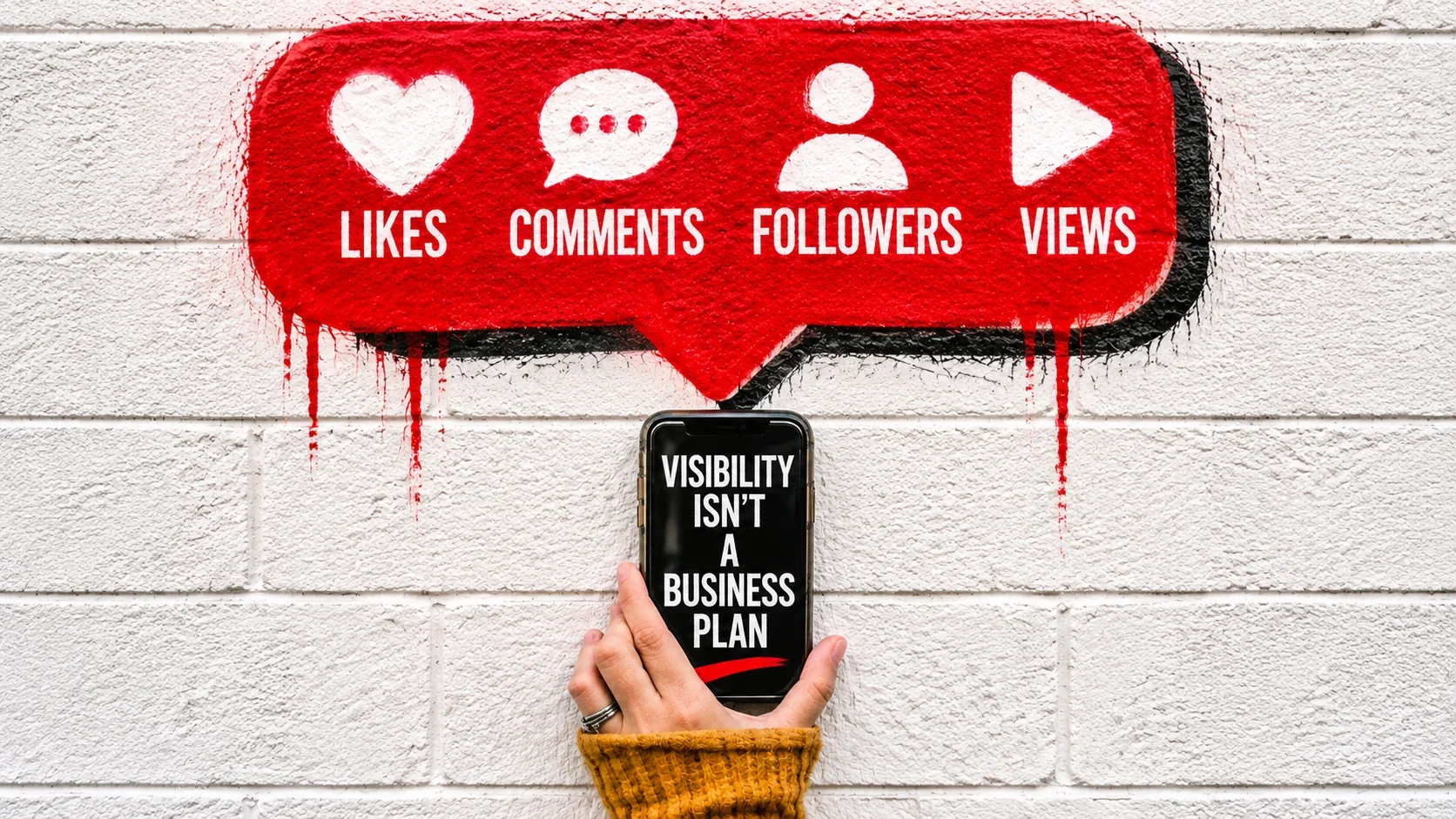
Visibility isn’t a business plan. In 2027, businesses need more than likes, followers, and views. They need marketing that turns visibility into trust and customers.
Businesses have never had more ways to reach customers. So why are so many still struggling to convert attention into sales? The answer reveals what marketing needs to change in 2027.
By Marketing Savvy Online | Beth K. Matthews | November 2026
Something is fundamentally wrong with the way businesses have been taught to measure marketing success.
We have created an entire culture around visibility. Businesses celebrate impressions, obsess over follower counts, chase viral moments, and invest considerable time producing content for platforms that have convinced them more exposure is the answer to almost every marketing problem.
When the results disappoint, the advice is remarkably predictable. Post more consistently. Improve your hooks. Experiment with different content formats. Increase your advertising budget. Learn the latest algorithm. And, of course, don't forget to engage with your audience.
But one question rarely gets the same attention.
What if visibility was never the problem?
What if customers are already finding your business, encountering your content, and considering your services, but something in your marketing isn't giving them a compelling reason to move forward?
It's an important distinction because businesses can spend years trying to solve a customer acquisition problem with more content, never realizing that the underlying issue has little to do with how often they're seen.
As we approach 2027, that distinction is becoming harder to ignore.
Artificial intelligence is changing how people discover and evaluate information. Consumers have more opportunities to investigate businesses before purchasing. Generic marketing messages are becoming increasingly interchangeable, and the platforms businesses rely on for exposure are evolving in ways that don't always translate into more website traffic or customers.
None of this means marketing is dying. It means the gap between generating attention and creating measurable business value deserves much closer examination.
Businesses that fail to recognize that gap may find themselves working harder, publishing more frequently, and paying more for marketing that never addresses why customers aren't buying.
The Marketing Funnel Was Always Neater on Paper Than in Real Life
One of the most persistent ideas in marketing is that customers follow a predictable path to purchase. They discover your business, develop interest, consider your offer, and eventually make a decision.
It's a useful framework for organizing marketing activities. The trouble begins when businesses confuse the framework with the customer's actual behavior.
People don't necessarily encounter a business and proceed through a carefully organized sequence of marketing messages. They investigate, compare, become distracted, reconsider, and sometimes return weeks or months after their first interaction.
Someone might discover a marketing consultant through a TikTok video explaining why boosted Facebook posts aren't generating customers. The video resonates because they've experienced that exact frustration, but they're not prepared to hire anyone. They keep scrolling, and the interaction ends without an inquiry or any clear sign the content influenced their thinking.
Later, while reviewing their advertising expenses, they search for information about why paid traffic isn't converting. They visit several websites, read a few articles, and begin questioning whether the problem is actually their advertising. Eventually, they return to the consultant's website, but their purpose has changed. They're no longer simply curious about marketing; they're evaluating whether this consultant understands their situation well enough to help.
This is where the quality of the business's digital presence matters more than how often its content appears in someone's feed. If the website offers vague promises about growing brands, maximizing results, and taking businesses to the next level, the visitor may leave unconvinced. If it demonstrates an understanding of their specific problem, explains the diagnostic process, and shows what makes the consultant's approach different, the visitor has something meaningful to evaluate.
The difference isn't necessarily how many times the person encountered the business. It's what they learned from those encounters.
Google's consumer research describes this nonlinear purchasing behavior as the messy middle, where people move between exploring possibilities and evaluating alternatives before deciding. That research challenges the assumption that businesses can simply push customers through a predetermined sequence of marketing messages.
Yet marketing advice still circulates claims that consumers must see a brand a specific number of times before purchasing. For years, the familiar figure was seven or eight exposures. Now we're seeing much larger numbers presented as though every buying decision follows the same formula.
Purchasing a $25 household product is fundamentally different from hiring a $5,000 consultant, selecting a contractor, or investing in an ongoing professional service. Price, risk, urgency, past experience, and the availability of alternatives all influence how much information a customer needs and how long they may take to decide.
A business trying to increase customer acquisition by repeatedly exposing people to the same message may therefore be overlooking the actual obstacle. Those prospective customers might already recognize the business, understand the general service it provides, and even have a favorable impression of its content. What they may not understand is whether the service addresses their particular circumstances, how the engagement works, or why one provider is a better choice than another.
Customers don't necessarily need to see more of your marketing. They may need your marketing to answer better questions.
That is where a properly developed content strategy becomes valuable. Rather than treating educational content as material needed to fill a publishing calendar, businesses should consider how different pieces of information help customers make informed decisions. Someone discovering a problem may need to understand its causes and consequences, while someone comparing providers may be looking for evidence of experience, transparent service descriptions, or reassurance about what happens after making an inquiry.
When businesses treat every interaction as another opportunity to deliver the same promotional message, they miss the opportunity to address the uncertainty that may be preventing a purchase. Understanding those differences will matter far more in 2027 than memorizing an arbitrary number of brand exposures.
Artificial Intelligence Is Changing Discovery—and Exposing Weak Visibility Strategies
For years, businesses have been encouraged to think about digital visibility primarily through social media reach and traditional search rankings. Both remain relevant, but the environment in which customers discover businesses is changing in ways that complicate the relationship between exposure, website traffic, and customer acquisition.
Search engines now incorporate AI-generated responses into many searches, letting consumers ask conversational questions, compare alternatives, and get summaries without necessarily visiting the websites that supplied the underlying information. Customers can also use conversational AI tools independently of traditional search engines, which introduces additional opportunities for businesses to be discovered while making the path from discovery to a website visit less predictable.
In July 2025, Pew Research Center published an analysis of Google search behavior showing that users clicked traditional search results in 8% of visits where an AI summary appeared, compared with 15% of visits without one. The research does not establish that AI summaries caused every difference in clicking behavior, nor does it mean search engine optimization has become irrelevant. It does, however, show why businesses need to reconsider the assumption that appearing in search results will necessarily produce the same website traffic patterns they have come to expect.
A prospective customer may encounter information about your industry without visiting your website, discover your business through a conventional search result or an AI-assisted answer, and then investigate several competitors before deciding which one deserves further consideration. These interactions can build awareness and drive evaluation without producing a straightforward sequence of measurable website visits.
This is why I believe businesses need to stop treating visibility as a single marketing metric. Being present somewhere in the digital environment tells us very little about whether the business is reaching customers with relevant needs, communicating its value effectively, or creating opportunities for qualified inquiries.
Being Seen Is Not the Same as Being Found for the Right Reason
A business can generate thousands of video views from people who have no immediate or foreseeable interest in purchasing its services. At the same time, another business with a much smaller social media audience may be consistently discovered by customers searching for the exact solution it provides.
Determining which business has the stronger marketing position requires examining the quality of those interactions, the business's economics, and what happens after discovery. The first business may have created valuable awareness, while the second may be better positioned to capture existing demand. An effective strategy may require both, but confusing their purposes can lead to poor investment decisions.
Consider a business that produces engaging entrepreneurship content but sells specialized bookkeeping services. Its videos might attract thousands of aspiring business owners who enjoy motivational content, while its website remains difficult to find when an established company searches for bookkeeping support. The business has developed an audience, but the relationship between that audience and the services it needs to sell remains weak.
Producing more motivational videos may increase its reach without improving its ability to attract qualified bookkeeping inquiries. Addressing the problem requires a closer look at how the business is positioned, what its intended customers actually search for, whether its website clearly communicates its services, and which channels bring relevant prospects into the customer journey.
This is what we mean by visibility architecture at Marketing Savvy Online.
Visibility architecture describes the deliberate relationship between how a business is discovered, how it communicates its value, how it establishes credibility, and how it guides prospective customers toward an appropriate next step. It recognizes that visibility has limited commercial value when the surrounding digital experience fails to support the customer's decision.
A website with strong search visibility but poor messaging has a different problem from a website with excellent messaging that prospective customers rarely discover. Both may struggle to generate inquiries, but recommending the same marketing solution to each would make very little sense. One business may need to improve the clarity and relevance of its existing pages, while the other may need to strengthen its discoverability among customers actively seeking its services.
This is why visibility needs to be diagnosed before it is expanded. As AI continues to change the discovery environment, businesses that understand where their customers come from, what those customers are trying to accomplish, and why they ultimately choose one provider over another will have a stronger foundation for adapting than businesses relying exclusively on reach and traffic reports.
AI Has Made Content Easier to Produce. It Hasn't Made Expertise Easier to Replace.
Another consequence of artificial intelligence deserves far more attention.
We are rapidly approaching a point where producing polished marketing content requires very little evidence that the person publishing it understands the subject. A business can generate an entire month of social media posts in minutes, create professional-looking graphics, publish articles, and produce educational videos that sound remarkably similar to material published by established professionals.
For businesses with limited resources, these capabilities can be enormously useful. The concern isn't that artificial intelligence makes content production more accessible; it's that accessibility changes what customers can reasonably infer from the quality of a business's presentation.
When every business can publish competent-sounding advice, polished content becomes a less reliable indication of the expertise behind it. The competitive distinction increasingly depends on whether the business can demonstrate judgment, relevant experience, and an understanding of problems that generic recommendations can't adequately address.
Take a common marketing topic: why Facebook advertising isn't generating customers.
A surface-level article might explain the importance of audience targeting, compelling visuals, strong calls to action, and appropriate budgets. None of that information is necessarily incorrect, but it provides little insight into why a particular business is experiencing disappointing results.
An experienced marketing professional should be able to take that discussion further by examining whether the advertising reaches customers with purchasing intent, whether the offer matches their needs, and whether the destination receiving the traffic gives visitors a reason to inquire. A campaign can generate inexpensive clicks while attracting people unlikely to purchase, just as a well-targeted campaign can underperform when the landing page fails to communicate the service's value.
The distinction matters because the recommended solution changes depending on the cause. Adjusting audience targeting will not necessarily fix a confusing offer, and rewriting ad copy won’t solve a website that lacks the information customers need to decide.
That's the difference between information and expertise. Information explains generally recommended practices, while expertise helps identify which variables matter in a particular situation, what the available evidence supports, and what should be investigated before committing additional resources.
AI can assist with research, analysis, organization, and communication, helping knowledgeable professionals work more efficiently. It cannot turn an unsupported marketing promise into a credible one merely by making the language more persuasive.
The Credibility Problem Behind AI-Generated Authority
The widespread availability of AI-generated content also creates an opportunity to manufacture the appearance of authority without establishing the substance behind it. Businesses can produce sophisticated websites, convincing visual presentations, and confident marketing copy before demonstrating the experience or capabilities those materials imply.
This does not mean every business using AI is being deceptive. It means professional presentation and professional competence are becoming harder to distinguish by appearance alone, increasing the importance of credible evidence that supports a business's claims.
A polished website is not sufficient evidence of expertise, just as a confident article does not prove that its author understands the industry. A compelling customer story cannot legitimately function as a testimonial unless it represents a genuine customer experience, and impressive marketing promises become questionable when the business provides no meaningful explanation of how it intends to deliver them.
Businesses should also consider transparency when AI is used in ways that could materially affect customer expectations about authenticity. A generated representation of a customer experience, for example, raises different concerns from using AI to help organize an article or edit a draft.
The larger issue is whether the business is contributing something genuinely useful. Customers can already obtain broad explanations of marketing concepts, compare general recommendations, and explore potential solutions through search engines and AI assistants. A business that publishes only variations of widely available information gives prospective customers little reason to regard its content as evidence of distinctive expertise.
The businesses that stand out in 2027 won't do so simply because they can produce more information. They'll need to demonstrate the judgment, experience, and perspective behind the information they publish.
That requires being willing to question popular advice, explain why certain recommendations may not apply, and show how professional knowledge changes how a problem is evaluated. Not every article or video needs to be a sales pitch; helping someone understand a problem they previously misunderstood can be more persuasive than another promotional claim.
The Content Creation Obsession Has Created a Measurement Problem
If there's one marketing habit I would challenge heading into 2027, it's the assumption that publishing more content is a reasonable first response to disappointing results.
When sales are slow, businesses are encouraged to post more often. When engagement declines, the recommendation is often to experiment with new formats or improve the creative. When advertising produces disappointing results, attention frequently turns toward better hooks, broader distribution, or increased budgets.
Each of these recommendations can be appropriate under the right circumstances. The problem is that they're often presented before anyone has established what is actually preventing the business from achieving its objectives.
We've built an industry around recommending activities that are relatively easy to produce and measure, while the harder work of identifying the underlying commercial problem gets far less attention. Social platforms reinforce this tendency by providing an enormous amount of feedback about content performance, including impressions, watch time, reactions, engagement, and audience growth.
Those measurements can provide valuable information about how content is being distributed and received. They become misleading, however, when businesses interpret improvements in platform activity as evidence of progress toward objectives the metrics were never designed to establish.
A business owner sees an increase in views and assumes the strategy is gaining traction. A marketer reports improved engagement and presents it as evidence that the content is performing well. The next month's publishing calendar becomes more ambitious because the available numbers suggest the approach is working.
Meanwhile, qualified inquiries remain unchanged.
The problem isn't necessarily that the content is ineffective. It may be accomplishing an awareness objective or reaching an audience that could become valuable over time. The problem is that nobody has established whether the results being celebrated are connected to the business outcome that justified the investment.
When the Metrics Look Better Than the Business
Imagine a business spending $500 promoting a service. The campaign produces 10,000 impressions and 200 website clicks, resulting in a 2% click-through rate and an average cost per click of $2.50.
On the surface, the campaign has generated measurable activity. People encountered the advertising, some responded, and traffic reached the website. A performance report could accurately describe those results without revealing whether the investment created a single meaningful sales opportunity.
Suppose none of those visitors became a qualified lead.
The business now has a problem that requires investigation rather than an automatic increase in advertising spend. It needs to understand whether the campaign attracted the intended audience, whether the offer aligned with visitor expectations, whether the landing page communicated sufficient value, and whether inquiries were being tracked accurately. The length of the purchasing process may also matter, particularly for services where customers typically require more time before making contact.
Without examining those variables, increasing the budget could simply direct additional traffic toward the same unresolved obstacle. The business would be spending more money to expand an activity whose relationship to customer acquisition remains unclear.
This is where vanity metrics become more than a harmless distraction. They can influence financial decisions by creating confidence in a strategy before the business has established whether th’s contributing to its objectives.
Impressions, clicks, and engagement are not meaningless measurements. They describe specific interactions and can help explain different aspects of campaign performance. The mistake is treating them as proof of outcomes they do not measure.
A metric can be accurate and still be irrelevant to the decision you're trying to make.
A business pursuing awareness may reasonably prioritize reach, while one seeking qualified inquiries needs to understand whether its marketing is attracting prospective customers with relevant needs. A business focused on profitable growth must go further, examining the relationship between customer acquisition costs, sales outcomes, and the value of the customers it acquires.
These objectives require different forms of evaluation, and no single platform dashboard can automatically resolve every question.
Not every business can attribute each sale perfectly to a particular marketing interaction. Purchasing journeys are complex, customers move between channels, and privacy limitations can restrict available information. But imperfect attribution is not a reason to abandon business outcomes in favor of whichever platform numbers appear most impressive.
It is a reason to be more disciplined about what the available evidence actually shows and to recognize when further investigation is needed before making another investment.
Trust Is Becoming the Deciding Factor That Marketing Cannot Simply Manufacture
For all the attention given to algorithms, AI, content formats, and advertising technology, one of the most important influences on purchasing remains remarkably human: customers want confidence that they're making a good decision.
The information available to consumers has expanded considerably, giving them more opportunities to investigate the businesses competing for their attention. Reviews, search results, websites, business listings, independent recommendations, and AI-assisted research can all influence how a prospective customer evaluates an offer.
The 2025 Edelman Trust Barometer Special Report on brands found that trust had become as important as price and quality among the purchase considerations it examined. That finding matters because businesses frequently approach trust as something they can create through attractive branding, engaging storytelling, or repeated exposure, when confidence is also shaped by what customers discover independently.
A business might communicate beautifully on social media and undermine that impression within seconds of someone arriving on its website. The problem may have nothing to do with visual design. The website may fail to explain the service clearly, make claims without supporting evidence, or create inconsistencies that leave visitors uncertain about what the business actually provides.
I've often argued that a website should function as more than a digital brochure. It needs to establish relevance and credibility while helping prospective customers understand whether the business can solve their particular problem.
A professionally designed website can still fail at that responsibility. A compelling headline may create interest without explaining the service, while generic testimonials can make a page look complete without offering the evidence a cautious customer needs. When every competitor describes itself as exceptional, innovative, passionate, and committed to customer satisfaction, those claims become hard to distinguish.
Your Marketing Is Making Promises Your Digital Presence Has to Support
Consider a contractor whose advertising emphasizes reliability and professionalism. A prospective customer responds to the message, visits the website, and discovers outdated information, incomplete project descriptions, and no clear explanation of how estimates are handled.
That experience does not prove the contractor is unreliable, but it raises questions the advertising initially seemed to resolve. The customer may begin wondering whether the business is organized, whether its information is current, and whether making contact will lead to a straightforward process.
A professional service provider can create similar uncertainty by promising strategic clarity while publishing conflicting descriptions of its services across its website and social media accounts. The inconsistency does not prove the business lacks expertise, but it places an unnecessary burden on prospective customers already trying to compare alternatives.
In either situation, the business may never know that the inconsistency influenced the decision. The customer can simply keep researching other providers without explaining why they rejected the original offer.
This is one reason I believe website trust signals deserve the same scrutiny businesses routinely give their advertising campaigns.
A trust signal is not merely a badge, review widget, or testimonial placed near a call-to-action button. It is evidence that helps resolve a question the customer reasonably has about the business. Depending on the industry, that evidence might involve qualifications, relevant examples of work, clear policies, consistent contact information, authentic customer experiences, or a transparent explanation of how the service is delivered.
The purpose is not to decorate a website with as many credibility cues as possible. It is to understand which uncertainties matter to the intended customer and provide relevant, verifiable information that helps resolve them.
This becomes especially important as AI-generated content makes professional-looking marketing materials easier to produce. When polished presentation is widely accessible, businesses need to focus more on the substance behind their claims.
Trust isn't something your marketing gets to declare. It's something the customer decides your business has earned.
If the website contradicts the impression created by the advertising, increasing the advertising budget may expand awareness without addressing the uncertainty that is preventing prospective customers from moving forward.
Customers Are Tired of Being Sold To, but That Doesn't Mean They've Stopped Buying
Another interesting contradiction in modern marketing is that businesses are encouraged to sell more frequently while consumers become increasingly familiar with the tactics used to create purchasing pressure.
Artificial scarcity, perpetual promotions, dramatic countdown timers, and repeated claims that an offer is about to disappear may generate short-term responses in some circumstances. When those claims aren't genuine, however, they can undermine the confidence a business needs to establish.
A company that announces only two openings remain every week for several consecutive months invites questions about the credibility of its promotional messaging. Even when urgency is legitimate, it cannot compensate for a customer who still doesn't understand the value of the product or service being offered.
This is where storytelling has an important role, although I think the concept is often oversimplified.
Marketing advice often encourages businesses to tell more stories because stories attract attention, make information memorable, and make sales messages feel less promotional. Those benefits can be valuable, but storytelling without a meaningful connection to the customer's circumstances is simply another form of content.
A compelling narrative should help someone understand why a problem exists, why it matters, and what changes when it’s addressed. For a service business, that may involve demonstrating the difference between treating a symptom and diagnosing its cause.
Consider a business owner who has spent several months increasing advertising expenditures because sales have been disappointing. The owner assumes the business needs more traffic, so they launch additional campaigns, and the budget continues to grow.
However, an examination of the website reveals that prospective customers cannot easily determine which service they need, what an engagement involves, or how the business differs from competing providers. The advertising may be generating genuine interest, but the destination is ’t providing enough information to support the next decision.
The business wasn't necessarily failing to attract attention. It was paying to direct attention toward an unclear offer.
That realization shifts the conversation from how much more advertising the business should buy to whether its existing marketing can convert the interest it already generates. It also creates a legitimate reason to investigate the problem without manufacturing a crisis or inventing a deadline.
Why You, Why Now, and What Happens Next?
Before asking someone to purchase, a business should be able to explain why a customer should choose it over available alternatives, why addressing the problem matters now, and what will happen after the customer decides to proceed.
These are not simply objections a salesperson needs to overcome. They are reasonable considerations that help prospective customers evaluate risk, relevance, and value.
Businesses often assume these answers are obvious because they know their services intimately. Customers, however, encounter the offer without that same background knowledge. They may be comparing several providers, weighing competing financial priorities, or deciding whether the problem is significant enough to address.
Clear explanations of the service process can reduce uncertainty about what an engagement involves, while relevant evidence of expertise can help customers distinguish one provider from another. Explaining the practical consequences of leaving a problem unresolved can also establish a legitimate reason for action, provided those consequences are realistic and supported rather than exaggerated for promotional effect.
You don't need to invent urgency when the customer's circumstances already provide a meaningful reason to consider. Effective marketing should make that relationship understandable and help the customer evaluate whether the proposed solution is appropriate.
People don't necessarily need another reminder that your offer exists. They need enough relevant information and confidence to determine whether it is the right choice for them.
Businesses Are Renting Attention While Neglecting the Assets They Actually Control
Perhaps the most overlooked vulnerability in modern marketing is how much of a business's customer acquisition strategy may depend on access controlled by somebody else.
Social platforms determine how content is distributed, advertising platforms influence the cost of reaching particular audiences, and search engines continuously evolve how information is organized and presented. Businesses can influence their performance within these systems, but they do not control the systems themselves.
Despite that uncertainty, countless business owners continue building their marketing presence around platforms where access to an audience can change with little warning. A business may invest years developing a following only to discover that reaching those same people now requires additional advertising, different content formats, or a level of publishing activity it cannot reasonably sustain.
This is why I've consistently advocated for search-first marketing and owned distribution. Social media remains an important discovery and communication channel, but it should contribute to a larger marketing structure rather than become the structure itself.
A business can build an impressive following and still struggle to turn that audience into durable customer relationships if it never develops meaningful pathways beyond the platform. The attention may be valuable, but the business remains dependent on a third party to decide how often its content reaches people who have expressed interest.
A website provides a place to establish a consistent identity, organize useful information, explain services, and invite inquiries. A permission-based email audience creates opportunities to maintain relationships without relying exclusively on algorithmic distribution. Original articles can answer customer questions, support search discovery, reinforce expertise, and provide a foundation for other marketing materials.
These assets still require maintenance, sound technical practices, and thoughtful distribution. Owning a website does ’t guarantee search rankings, and maintaining an email list does ’t guarantee engagement. The advantage is greater control over how the business communicates its value, maintains relationships, and supports customers as they evaluate its services.
One Article Can Do More Than a Month of Disconnected Content
Consider the difference between publishing thirty unrelated social media posts and developing one substantial article that addresses a specific problem your ideal customer is actively researching.
A well-developed article can establish the problem, examine why common solutions fail, explain the decisions that matter, and provide guidance that helps the reader evaluate possible next steps. Instead of offering a few isolated observations, it creates a useful resource that connects the customer's questions to the business's area of expertise.
That article can then become the foundation for several videos, each exploring a particular question or misconception in greater depth. It can support an email conversation, serve as a resource during a sales inquiry, and become part of a growing collection of material tied to the business's services.
The result is a more deliberate relationship between content creation and distribution. Rather than producing thirty disconnected opportunities for engagement, the business develops assets that reinforce one another and give interested customers somewhere meaningful to continue their research.
This is not an argument against publishing frequently. A well-developed distribution strategy may involve frequent content across several channels, particularly when the business has the resources and audience demand to support it. The distinction is whether that content contributes to a broader objective or exists primarily to maintain activity within a platform.
If a social media video introduces a problem, the website should be prepared to help the customer investigate it. If an article demonstrates expertise, the service pages should explain how that expertise translates into an actual engagement. And when a customer returns later, the business should be recognizable, credible, and reasonably easy to find again.
That is what happens when distribution is built around a business rather than when the business is built around distribution.
The Real Marketing Opportunity for 2027 Is to Stop Guessing
Every year brings another collection of marketing predictions, and 2027 will be no exception. New platforms will emerge, AI tools will become more sophisticated, content formats will change, and marketers will continue announcing which tactics businesses supposedly must adopt before their competitors do.
Some developments will create genuine opportunities, while others will become temporary distractions. The challenge for business owners is not identifying every trend before it becomes popular, but developing enough clarity about their own marketing to determine which changes actually matter to their customers and business model.
A local service provider does not necessarily need the same marketing strategy as a national ecommerce company. A new business establishing initial awareness has different priorities from an established company generating substantial website traffic but struggling to convert visitors into qualified leads.
Yet the marketing industry routinely distributes broad prescriptions without adequately accounting for those differences. Businesses are encouraged to invest in more video, more advertising, more automation, and more content without first determining whether those activities address the obstacle preventing growth.
Businesses need a better understanding of the relationship between the effort they're investing and the outcomes they're trying to achieve.
If a business isn't generating enough qualified inquiries, the investigation should start by determining whether prospective customers can find its services, whether its messaging attracts the right audience, and whether the available information gives those customers enough reason to engage.
When inquiries arrive but rarely turn into sales, the investigation may need to shift toward offer suitability, pricing, expectations, customer experience, or the sales process. A business generating sales at an unsustainable acquisition cost faces another set of decisions involving profitability, channel efficiency, and the long-term value of its customers.
These situations may produce similar frustrations for a business owner, but they do not share the same causes. Treating them all as reasons to publish more content or increase advertising spend risks directing resources toward activities that cannot reasonably resolve the underlying problem.
Clarity Before Spend Is More Than a Marketing Philosophy
At Marketing Savvy Online, we believe businesses deserve to know what they're trying to fix before we encourage them to spend more money fixing it.
That's why our approach emphasizes diagnosis rather than automatically prescribing another campaign, content calendar, or platform. A Visibility Baseline Audit examines how a business is positioned for discovery and where its digital presence may limit opportunities, while a Website Trust Signal Audit assesses the clarity and credibility customers encounter when evaluating the business.
These services approach marketing performance from different but connected perspectives. Discoverability matters because customers cannot consider a business they cannot find, while credibility and clarity matter because being discovered does not automatically make a business the preferred choice.
Neither audit assumes that more advertising or content is the answer. The objective is to identify potential gaps, understand their implications, and provide business owners with a clearer basis for deciding where further investment may be appropriate.
Marketing should not become an endless cycle of spending money to compensate for problems that have never been properly identified. The cost of ineffective marketing extends beyond the advertising budget to include time spent pursuing the wrong solution, opportunities that fail to develop into inquiries, and decisions influenced by performance reports that provide an incomplete picture of what the business needs to understand.
A company can invest considerable effort in improving the numbers it knows how to measure while overlooking the experience its customers are actually having. Without examining that relationship, additional marketing activity may create the appearance of progress without improving the underlying business performance.
2027 Won't Reward Businesses Simply for Being Louder
The greatest marketing advantage heading into 2027 may not be the ability to produce more content, command more attention, or master another algorithm. It may be the willingness to question whether the business's current marketing is accomplishing what it was intended to do.
That requires examining the entire relationship between discovery and purchasing rather than evaluating each marketing activity as an isolated success or failure. When prospective customers discover a business but do not inquire, the explanation may involve relevance, messaging, credibility, or uncertainty about the offer. When an audience grows while revenue remains unchanged, the business needs to understand whether that audience contains potential customers and whether its content is connected to meaningful purchasing opportunities.
Similarly, advertising that generates traffic without producing qualified leads deserves a different investigation from advertising that generates strong leads but fails to produce profitable sales. These distinctions are important because the correct response depends on identifying the actual constraint, not simply increasing the activity most visible in a performance report. If you’re facing that decision now, here’s how to diagnose why your marketing isn’t bringing in customers using your search data, inquiry records, and sales follow-up.
Businesses that approach 2027 with a clear understanding of their visibility, positioning, credibility, and customer journey will be better equipped to determine where additional investment makes sense. They will not be immune to changing technology, economic conditions, or competitive pressure, but they will have a stronger foundation for evaluating opportunities without becoming dependent on every new marketing trend.
For business owners who have spent years investing in greater visibility without understanding why that attention isn't translating into customers, the next step may not be another content calendar or advertising campaign. It may be a closer examination of the marketing system they've already built and the assumptions that have shaped their spending decisions.
Being seen is an opportunity. Being trusted is an advantage. Being chosen is the outcome your marketing needs to help make possible.
The real question for 2027 isn't simply how many more people you can get to notice your business. It's whether the people who have already discovered it are finding the information, credibility, and compelling reasons they need to choose you.
And if they aren't, increasing visibility without addressing those gaps may only make the same problem more expensive.
About Marketing Savvy Online
Marketing Savvy Online helps businesses understand the gaps between digital visibility, customer trust, and marketing performance.
Through diagnostic services including the Visibility Baseline Audit and Website Trust Signal Audit, we help identify potential obstacles to customer discovery and conversion so business owners can make more informed marketing decisions.
Our philosophy is simple: Clarity before spend.
Explore our services at MarketingSavvy.online.
Research & References
Google — Decoding Decisions: Making Sense of the Messy Middle
Research examining how consumers move between exploration and evaluation before purchasing.
Pew Research Center — Google Users Are Less Likely to Click on Links When an AI Summary Appears in the Results (July 22, 2025)
An analysis of observed search behavior examining how clicking patterns differ when AI-generated summaries appear.
Edelman — 2025 Trust Barometer Special Report: Brand Trust, From We to Me
Research examining the importance of brand trust in consumer purchasing decisions.
https://www.edelman.com/trust/2025/trust-barometer/special-report-brands
Google Search Central — AI Features and Your Website
Official guidance on how websites can approach visibility within Google's AI-powered search experiences.
https://developers.google.com/search/docs/appearance/ai-features
