
By Beth K. Matthews, founder of Marketing Savvy Online and author of Why Your Marketing Feels Close… But Never Fully Works
One person recommends a website redesign. Another says you need better advertising. Someone else is convinced you should be posting every day. Each recommendation sounds reasonable, and each comes with another expense. Meanwhile, you still cannot explain why the marketing you already have is falling short.
That is a good reason to consider a marketing audit. Before committing to another solution, you need an informed assessment of the business’s current marketing, the evidence behind its performance, and the problems worth addressing first.
A marketing audit is a structured review of your marketing strategy and performance. Depending on its scope, it can examine your positioning, website, content, search visibility, advertising, customer journey, and measurement. Its value lies in helping you make a better decision about what happens next.
For a small business, that decision can be consequential. You may be choosing whether to increase an advertising budget, replace a website, hire an agency, or stop investing in a channel that has become difficult to justify. The audit should help you understand whether the proposed change addresses the problem you actually have.
Start With the Decision You’re Trying to Make
“We need to improve our marketing” is a reasonable concern. It gives an auditor very little direction.
“We’re considering a website redesign because inquiries have declined, but we don’t know whether the site is responsible” gives the review a specific decision to inform. So does “Our advertising generates messages, but too few people want the service we’re trying to sell.”
The distinction matters because a business can have several weaknesses without all of them deserving immediate investment. An outdated photograph, an inconsistent headline, and a broken inquiry form may all appear in a review. Their significance depends on what the business needs its marketing to accomplish and what customers encounter along the way.
Before commissioning an audit, write down the decision you are facing, what prompted it, and what you currently know. Include the alternatives you are considering. If one option is spending more on ads and another is improving the service page, the reviewer should understand why those options are on the table.
You can begin that investigation yourself. Our guide to why your marketing isn’t bringing in customers explains how different symptoms point toward different parts of customer acquisition. An audit becomes useful when you need deeper evaluation, specialist knowledge, or an outside perspective to decide where to focus.
Choose a Scope That Can Answer Your Question
A comprehensive marketing audit can examine the business’s wider marketing environment, objectives, strategy, and execution. A focused audit can investigate a narrower area, such as website credibility, search visibility, advertising, or content direction.
Both can be appropriate. What matters is whether the scope supports the conclusion you need.
If customers are reaching a service page but hesitating to inquire, a review of that page’s clarity, credibility, and contact process may be a sensible starting point. If you do not know whether relevant customers are finding the business at all, the investigation needs to reach further into discovery and audience relevance.
Ask what will be examined and what information the reviewer will use. A public website review can identify confusing service descriptions, missing business information, or an inaccessible contact process. Access to analytics and inquiry records can support a different level of performance analysis. Customer research can help investigate questions those records leave unanswered.
The proposal should make those boundaries understandable. If an audit covers only public pages, you should know how the reviewer will distinguish visible problems from assumptions about their effect on sales. If it includes advertising performance, you should know whether the work examines campaign settings, the offer, the destination, or all three.
A clear scope protects your budget and gives the reviewer a fair question to answer.
Ask What the Findings Will Be Based On
A website can look dated and still bring in valuable work. A polished website can attract interest while leaving buyers uncertain about the service. Appearance deserves evaluation, but a visual opinion alone cannot explain performance.
Look for findings that connect an observation to its likely business consequence and show the basis for that interpretation.
For example, “Your services page needs stronger messaging” gives you a direction without much explanation. A more useful finding might identify that the page never states whether the service is intended for individuals or employers, while recent inquiries repeatedly come from people the business cannot serve.
That gives the owner something concrete to examine. The page omission is visible. The inquiry pattern is recorded. The relationship between them is a plausible explanation to investigate.
This distinction is especially important when a report presents a number. A score of 62 out of 100 may summarize a checklist, but you still need to understand how the score was calculated, which findings affect your priorities, and what the reviewer actually verified.
An audit should make its reasoning easier to inspect. You should be able to follow how the reviewer moved from the information available to the recommendation being made.
A Finding and Its Effect on Revenue Are Different Claims
Imagine a training business considering a complete website rebuild because too few visitors request information about its management workshops.
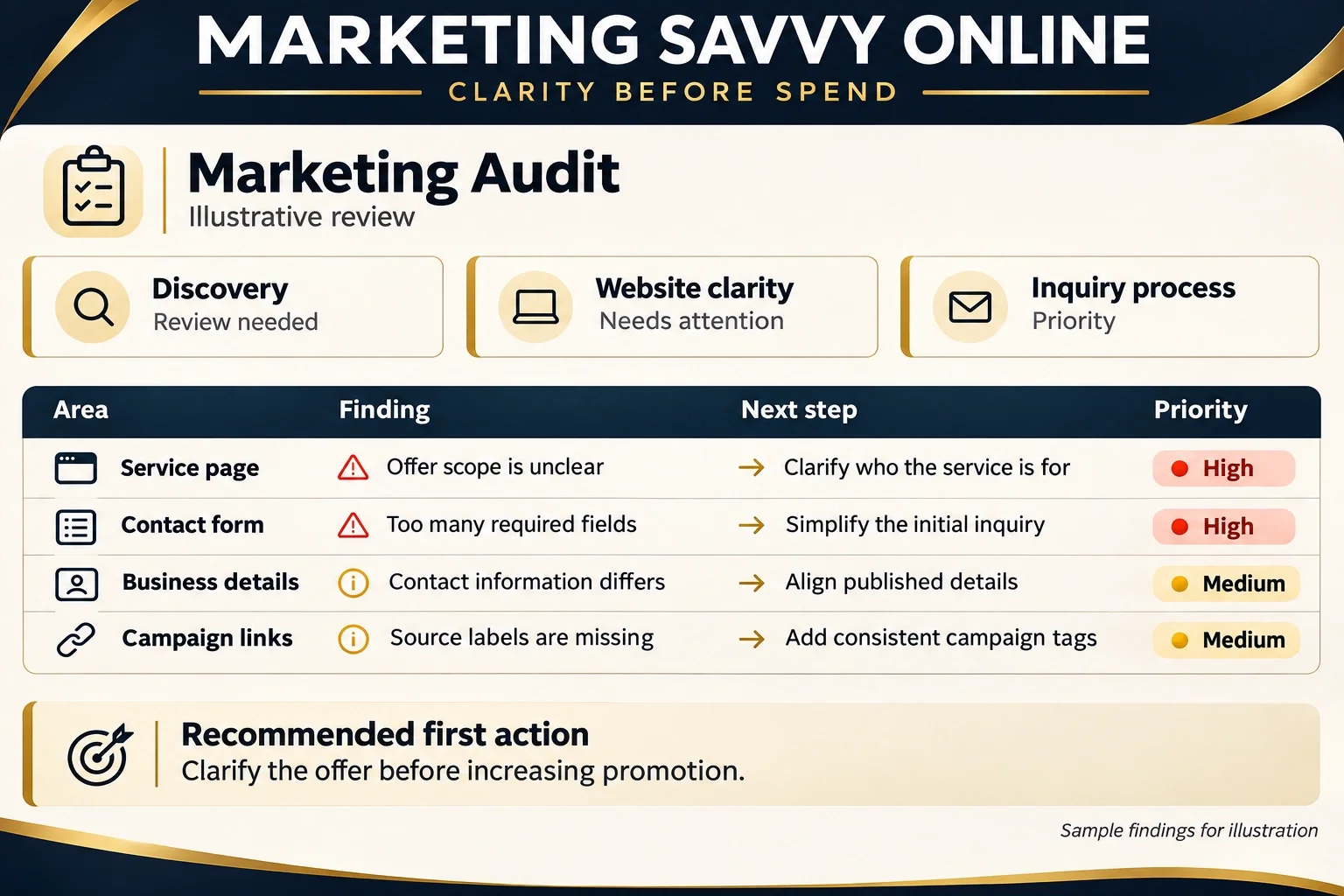
In this hypothetical example, the inquiry form has fourteen required fields. It asks for the company’s billing address, purchase-order details, and the names of all attendees before someone can ask about dates or availability.
A reviewer can confirm that those fields are required. They can also explain why asking for booking information at the inquiry stage may create difficulty. The stronger claim—that the form is responsible for a particular share of lost business—would require further evidence.
Watching prospective customers attempt the task could reveal where they struggle. Form-interaction data might show where attempts end, if that information is collected accurately. A carefully evaluated change could provide additional evidence over time.
Nielsen Norman Group’s guidance explains how different research methods answer different questions. Measurements help establish the extent of a pattern. Observation and other qualitative methods can help investigate why it occurs.
The audit might therefore recommend simplifying the initial inquiry, retaining essential qualification questions, and reviewing the quality and number of inquiries afterward. That is a proportionate next step supported by a visible problem.
The business may eventually benefit from a redesign. The form finding alone gives it a reason to test a more focused change before making that larger commitment.
Check Whether the Marketing Reports Describe Real Business Outcomes
Sometimes an audit needs to begin with the numbers themselves.
A dashboard may report “leads” when it is counting clicks on a contact button. A business owner may believe every reported conversion represents an inquiry, while the form records show something quite different.
In Google Analytics, a key event is an event designated as important to the business. Its meaning depends on the action being measured. A booking-page visit, a completed inquiry, and a paid booking represent different stages of customer behavior.
Before drawing conclusions, the reviewer should establish what the important metrics count and whether the information is reliable enough for the proposed analysis.
That may include checking whether forms reach the right inbox, whether test submissions appear in reporting, and whether paid work can be connected to recorded inquiries. The exact checks depend on the audit’s scope and the systems the business uses.
Where the records are incomplete, the report should explain what can still be assessed and what remains uncertain. Missing information can become a practical recommendation of its own. You may need a more reliable way to record inquiry sources or distinguish unsuitable requests from genuine opportunities.
The aim is to improve the decision you can make with the evidence available.
What Should You Receive From a Marketing Audit?
You should leave with a clear understanding of the findings, their importance, and the next actions the review supports.
For a business deciding where to invest, a useful deliverable explains which issues deserve attention first and why. It identifies dependencies, such as fixing measurement before judging a campaign, or clarifying a service before paying to promote it.
It should also acknowledge what is working. An effective service page, a dependable referral source, or a clear offer can be worth preserving while other parts of the marketing improve. A review that recommends changing everything can leave the owner unable to distinguish a necessary correction from someone’s preferred way of working.
Ask whether you will receive a written report, a recorded walkthrough, a discussion of the findings, or some combination. Find out how specific the recommendations will be and whether the work includes implementation.
An audit recommendation can lead to another project, but the review should already help you understand the reason for that project. You should be able to explain what it is intended to improve and how you would assess the result.
Can a Free Marketing Audit Be Useful?
A free review can identify an obvious problem, provide a useful outside observation, or help you understand whether a provider’s expertise fits your situation. A paid audit can provide more time for analysis, a defined scope, and a more substantial deliverable.
The price alone tells you little about the quality of the reasoning.
Before accepting either, ask what information will be reviewed, what you will receive, and whether you can use the findings without purchasing ongoing services. A brief review based on a website link has a different evidentiary foundation from an engagement that includes internal records and customer research.
Consider the provider’s perspective as well. An advertising specialist may be particularly good at identifying campaign problems. A website specialist may notice usability issues. Their expertise can be valuable, and it also shapes the areas they are likely to examine.
Ask how they will handle evidence that points beyond their usual service. A worthwhile recommendation might involve another specialist, an internal process change, or a smaller intervention than the owner originally expected.
When Is an Audit Worth Paying For?
An audit is worth considering when an unresolved question is affecting a meaningful business decision.
You may be preparing to spend substantially on a redesign or campaign without knowing what needs to change. You may have tried several tactics and received conflicting explanations for the results. Your marketing may look active while the connection to qualified inquiries remains unclear.
In those circumstances, a defined review can help you evaluate the next commitment.
There are also situations where the immediate action is already evident. If a contact form visibly fails, repairing and testing it is a sensible first step. If the business has only just launched and has little performance history, positioning work or a focused review may be more useful than an extensive performance assessment.
The decision depends on the uncertainty you need to resolve, the cost of choosing poorly, and whether the proposed audit has enough scope and access to improve your understanding.
Ask yourself what you would do differently after receiving the findings. If you cannot identify a decision the audit would inform, clarify its purpose before purchasing it.
How Much Does a Marketing Audit Cost?
The term covers work with very different scopes. Comparing prices requires comparing what the review includes.
The number of assets examined, the depth of analysis, the available records, and the deliverables all affect the work involved. A focused public-facing website review is a different engagement from an assessment involving several channels, internal performance data, and customer research.
At Marketing Savvy Online, the Website Trust Signal Audit starts at $450 and focuses on credibility gaps, structural friction, and inconsistencies that can create hesitation on a website. The Visibility Baseline Audit starts at $650 and examines website structure, content and messaging signals, platform alignment, and advertising continuity where applicable.
Those are the published starting prices for these specific services. When comparing any audit proposal, ask what the fee covers, what you need to supply, what you will receive, and how additional work would be scoped.
A lower fee may suit a focused question. A broader engagement needs a reason to be broader.
What Should You Prepare Before a Review?
Start with your business goals and the decision you want help making. Identify the services or products you most want to sell, the customers you intend to serve, and the results that prompted your concern.
Gather the relevant website and platform links, examples of current marketing, and any reports or inquiry records you already use. Recent proposals, common customer questions, and reasons prospects give for declining can provide valuable context when they fall within the agreed scope.
You do not need to manufacture a polished presentation. Accurate information about how the business operates is more useful than an idealized description of how the process should work.
Tell the reviewer what has changed recently. A new offer, a different service area, an increase in prices, or a change in how inquiries are handled can affect the interpretation of the results.
The better the business context, the easier it becomes to distinguish a marketing problem from an expectation, capacity, or process issue that marketing alone cannot resolve.
Leave With a Better Spending Decision
A marketing audit earns its place when it helps you understand the next decision more clearly.
You should know which findings are established, which explanations need further investigation, and which actions deserve priority. That may support more investment in a channel that is producing valuable work. It may point toward a clearer offer, a better inquiry process, or a technical repair before more promotion.
At Marketing Savvy Online, this is the purpose of Clarity Before Spend. We examine how a business is presented across its website, content, messaging, and platforms so the next marketing decision has a stronger foundation.
If your business needs that evaluation, explore our diagnostic marketing services.
Before buying another marketing solution, understand the problem you are paying it to solve.
References
Shopify — How to Conduct an Effective Marketing Audit
https://www.shopify.com/blog/marketing-audit
Nielsen Norman Group — When to Use Which User-Experience Research Methods
https://www.nngroup.com/articles/which-ux-research-methods/
Google Analytics — About Key Events
https://support.google.com/analytics/answer/9267568?hl=en
Marketing Savvy Online — Services and Published Starting Prices
https://marketingsavvy.online/services-marketing-savvy-online
